
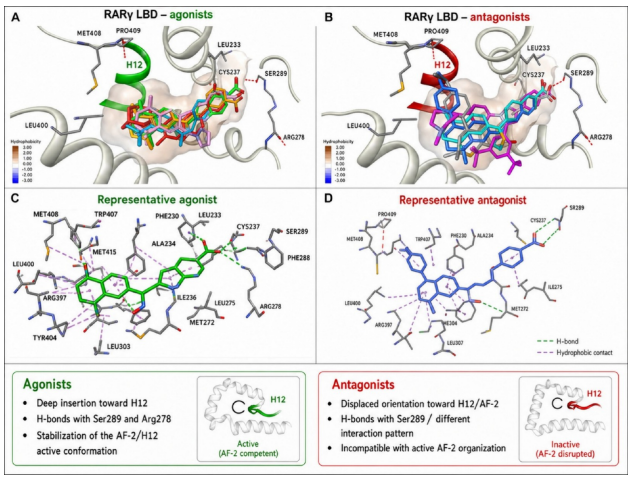
Synthetic ligands can switch RARγ and the vitamin D receptor (VDR) on or off, but what separates an agonist from an antagonist is not fully understood. This study uses docking, molecular dynamics simulations and binding-energy calculations to compare nine RARγ ligands and six VDR ligands.
The results suggest that function depends on more than binding strength. In RARγ, antagonists lose a key anchoring contact (Arg278) and shift toward the back of the binding pocket, near helix 12. In VDR, antagonists fail to engage His305. In both receptors, agonists are more energetically stabilized, and the separation is statistically clear for RARγ but only a trend for VDR. The team also solved new MicroED crystal structures of two RARγ ligands, AGN205728 and AGN194310.
The authors present this as a retrospective benchmark for understanding agonist and antagonist behavior. It is not yet a validated predictive tool