
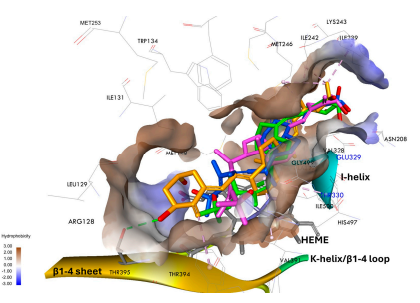
The active form of vitamin D3 (1,25D3) has anticancer potential, but its clinical use is limited by calcemic side effects and rapid breakdown by cytochrome P450 enzymes. This study characterises new vitamin D analogs (PRI-1927, PRI-1937, and PRI-1938) with extended, rigidified, and branched side chains, and compares them with the earlier analog PRI-1906. All three new analogs were significantly more resistant than 1,25D3. Molecular modelling and qunatum mechanical calculations show that PRI-1938 sits stably in the CYP24A1 active site, held by four hydrogen bonds and multiple hydrophobic interactions that limit access to the catalytic heme. The authors conclude that side-chain geometry is key to metabolic stability and support further development of PRI-1938 as an anticancer vitamin D analog.